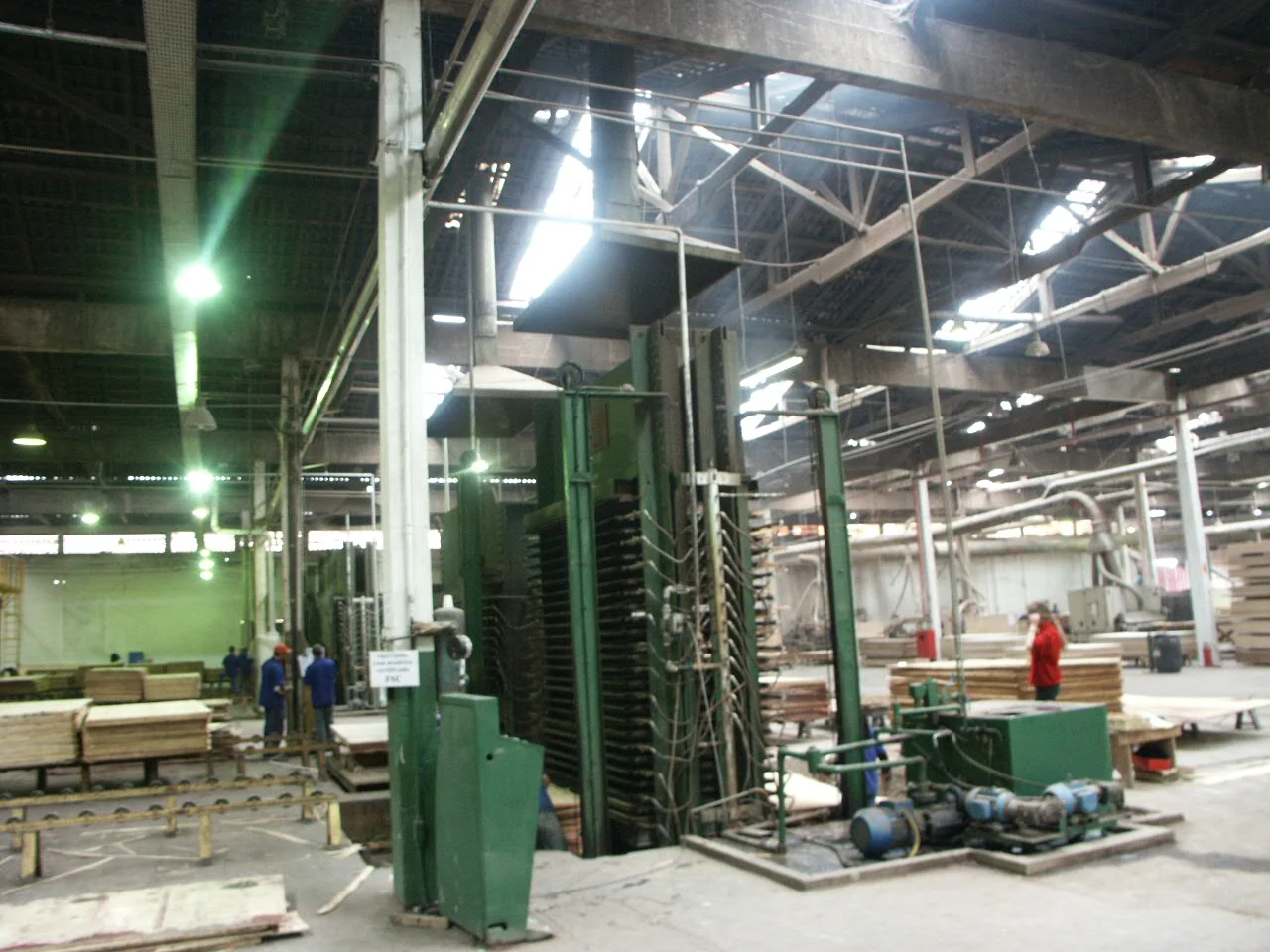
A multi-daylight plywood hot press consolidates repeated pressing positions into one batch machine for mills that need controlled platen area, pressure and handling rather than a generic catalogue size. Looking Forward Machinery helps plywood mills specify and source the press around panel dimensions, adhesive process, target cycle and factory interfaces. This page covers one machine selection: force versus specific pressure, platen size, openings, heating, daylight pitch and loaders. It does not promise a production rate, utility value or installation result before the press, material and site data are confirmed.
Start with the panel and the loaded area
Specify the press from the largest loaded panel arrangement, not from the finished panel name alone. Send the panel length and width, thickness range, veneer or board construction, trim allowance, number of panels per opening, adhesive process, target pressing schedule and required transfer direction. The platen must cover the loaded area with an engineering margin for alignment and edge conditions. Finished panel dimensions, caul or tray dimensions and the actual charge arrangement can therefore lead to different platen requirements.
A platen size is a working envelope, not a statement that every nominal panel size can be pressed in every arrangement. Check useful pressing area, platen thickness, flatness, temperature uniformity, frame clearance and the space needed for loader fingers or carriers. A larger platen may improve flexibility but can also change heating demand, structural design, transport and loading time. Looking Forward Machinery coordinates these inputs with the selected manufacturing route; unconfirmed limits remain open items in the quotation and drawing review.
The brochure provides one specific configuration example: 30 openings, a 1370 x 2700 mm platen and nominal total force of 8000 kN, with automated feeding, batch loading, unloading and stacking described around the system. It is a reference example only, not a standard offer, capacity guarantee or universal specification. Platen thickness of 40–100 mm is also a brochure example that requires confirmation for the selected design.
| Selection input | What to provide | Why it changes the machine |
|---|---|---|
| Panel and charge | Finished size, trim allowance, thickness, panels per opening | Sets useful platen area and loading arrangement |
| Material process | Veneer sequence or substrate, adhesive and pressing schedule | Defines heating, dwell and handling assumptions |
| Site interface | Floor level, pit or pit-free preference, infeed direction and clear height | Determines loader geometry and installation scope |
| Batch objective | Opening count, cycle definition and shift planning basis | Balances press size with material handling |
Separate specific pressure from total press force
Specific pressure describes the pressure applied to the loaded panel area, usually in MPa. Total press force describes the hydraulic or mechanical force the frame and cylinders must deliver. For preliminary sizing, use F[kN] = A[mm2] x p[MPa] / 1000. Here A is the loaded area for the pressure case being checked, and p is the target specific pressure. Confirm the actual pressure schedule, loaded area, safety margin, force distribution and structural design with the responsible engineer.
Do not multiply the calculated force by the number of serial daylights. In a stacked multi-daylight press with equal loaded area transmitted through the press structure, the force model is not simply one full panel force multiplied by openings. Unequal loads, multiple loads in one opening, caul stiffness, platen deflection, cylinder arrangement and frame reactions can change the engineering case. The opening count affects batch arrangement, pitch and handling; it is not by itself a multiplier for force.
For illustration only, a loaded area of 3,699,000 mm2 at 2.0 MPa gives 7,398 kN by the formula. This is a selection estimate, not a recommendation for a particular adhesive or panel. A real request should state whether the area is one panel, a set of panels or another defined load, and whether the specified pressure is nominal, peak or part of a time-based schedule. We will reconcile those definitions before a final force rating is issued.
| Term | Use in selection | Limit |
|---|---|---|
| Specific pressure | Target pressure on the defined loaded area, MPa | Must match the material and process basis |
| Total press force | Frame and cylinder rating derived from the defined load case | Not openings multiplied; confirm reactions and margins |
| Force formula | F[kN] = A[mm2] x p[MPa] / 1000 | Preliminary calculation only |
Choose openings and daylight pitch as a handling system
Openings, also called daylights, determine how many charges can be staged in one press batch. Select the number from the required batch size, panel thickness range, loader design, caul or tray stack, opening and closing sequence, and realistic cycle time. More openings can increase batch opportunity, but they also increase press height, alignment sensitivity, handling mass and the consequences of an unsuitable pitch. The correct answer is the opening count that the complete material-handling route can load, press and unload consistently.
Daylight pitch is the vertical distance from one pressing position to the next. It must accept the panel or charge thickness, cauls, carriers, loader fingers and the clearance required for entry and withdrawal. Measure the actual press-side transfer height rather than assuming that a nominal daylight equals usable loader clearance. Pitch, opening parallelism, platen travel, top clearance and floor elevation should be checked together. Any pit-free arrangement requires confirmation of infeed height, floor condition, available clear height and adjacent equipment interfaces.
Do not transfer a loading description across every machine. The brochure reference to a 30–80 opening loading and unloading system describes a handling concept, not a specification for all presses. A shared loader needs a timing study covering service time, travel, batch interval and conflicts. If two presses request service at once, utilization alone cannot prove that waiting is acceptable; schedule the sequence against the production window.
Match heating to the process, not to a headline temperature
Heating selection should begin with the adhesive system, panel construction, target pressing schedule, platen uniformity requirement, available thermal utility and local operating practice. Confirm whether the press will use thermal oil, steam, electric heating or another arrangement during engineering review. The machine concept must then address heating channels or elements, zoning, control points, warm-up behavior, insulation, condensate or utility connections where relevant, and access for maintenance.
A heating method is not a guaranteed cure recipe. We will not invent a safe temperature, adhesive formulation or dwell time from a machine description. The buyer should provide the intended material and process window, while the equipment configuration confirms how that window can be controlled. Initial hot pressing of glued veneer lay-ups is distinct from pressing an existing substrate with an overlay or laminate; an overlay press should not be treated as a substitute for the plywood lay-up and hot-press sequence.
Heating capacity, utility consumption, ramp time and temperature uniformity remain to be confirmed. Include these as acceptance and design questions rather than assumed performance claims. If the plant has existing thermal equipment, provide supply and return conditions, available capacity and connection location.
Define the loader interface and supply boundary
A loader is part of the press selection because its carriage, fingers, carriers or trays must enter each daylight without damaging the charge or interrupting the batch sequence. Confirm panel travel direction, loading side, press centerline, transfer height, opening pitch, charge stiffness, caul format, edge support and whether the press receives a prepared batch or individual charges. The requested scope may include automatic feeding, batch loading, unloading and stacking, but each interface must be shown on a layout before it is treated as included.
The press-only scope can cover the hot press, hydraulic or drive system, heating control and machine-side electrical controls as agreed. Optional scope may include loader, unloader, batch preparation, transfer conveyors, stacker, guarding and line controls. Customer-site scope may include foundations, building modifications, utilities, power distribution, lifting, buffers and downstream trimming. Installation, commissioning, acceptance criteria and training must be negotiated.
Before quotation, send a dimensioned layout or clear measurements: press location, loading side, existing equipment, floor elevations, columns, door and crane access, maintenance clearances and stack positions. Annotated layouts are illustrative planning aids, not actual installation drawings. Final drawings, load data, guarding and interfaces require engineering confirmation.
Use capacity examples only as planning estimates
A transparent calculation is more useful than an unqualified output claim. The planning formula is panels per shift = effective openings x panels per opening x (shift hours x 60 / complete cycle minutes) x utilization. The complete cycle includes loading, closing, pressing, opening, unloading and any associated reset or travel time measured inside that interval; do not subtract those activities again.
Hypothetical planning example only: 20 effective openings, 1 panel per opening, a 10-minute complete cycle, an 8-hour shift and 80% utilization produce 20 x 1 x (8 x 60 / 10) x 0.8 = 768 panels per shift. This is not guaranteed output and does not validate a press, loader, material quality, shift pattern or downstream capacity. Replace every input with measured or agreed project data before comparing configurations.
For the specific brochure example of 30 openings, do not infer 30 panels per cycle or a guaranteed output. The result depends on panel arrangement, useful openings, cycle definition, loading method, heating schedule, availability and stacking. Force, utilities, platen temperature and payback likewise remain preliminary until the design basis and acceptance method are documented.
What to confirm before a final quotation
A complete RFQ should identify the product, process and interfaces. Confirm maximum and minimum panel dimensions, thickness range, charge mass, panel count per opening, target specific pressure, opening count, daylight pitch, heating utility, control language, loading direction, site elevation, available utilities and supply boundary. Include drawings, photographs and the current cycle definition where an existing line is involved.
Looking Forward Machinery is a sourcing and configuration coordinator. We help plywood mills specify and source a suitable machine; we do not present the brochure supplier as our own factory, history, customer base, certifications or service organization. Unknown engineering data stays marked for confirmation. Contact Peter with panel dimensions, target process and layout for a traceable selection review.
Questions about this configuration
Does a 30-opening press require 30 times the calculated force?
No. Use F[kN] = A[mm2] x p[MPa] / 1000 for the defined loaded area and pressure case. Do not multiply by serial openings. Frame reactions, cylinder arrangement, unequal loads and structural margins still require engineering confirmation.
Is 30 openings, 1370 x 2700 mm and 8000 kN a standard machine specification?
No. It is a clearly labeled brochure configuration example only. Availability, platen details, heating, loader interfaces, force basis and all site requirements must be confirmed for the requested machine.
How do I choose daylight pitch?
Define the complete charge thickness including cauls or carriers, then add the clearance needed for loader entry, alignment and withdrawal. Verify pitch with transfer height, top clearance, platen travel and floor conditions; nominal opening size alone is insufficient.
Can the 768 panels per shift example be used as a production guarantee?
No. It is a hypothetical planning example based on 20 openings, one panel per opening, a 10-minute complete cycle, an 8-hour shift and 80% utilization. Actual output depends on the confirmed process, equipment and downstream balance.