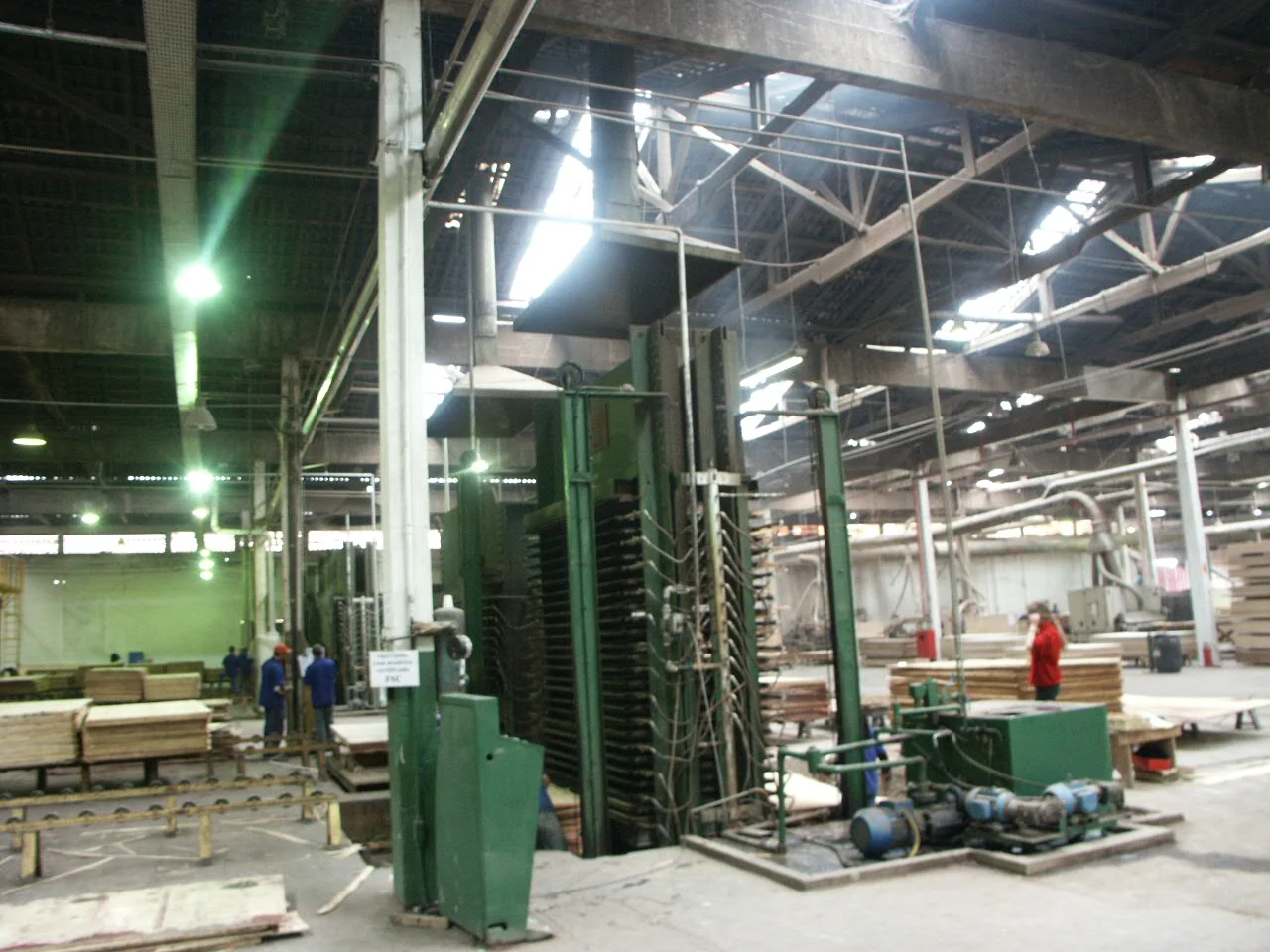
An automatic plywood hot press line connects the work completed before pressing with a controlled batch cycle and an orderly outfeed. Looking Forward Machinery helps plywood mills specify and source the handling, press, transfer and stacking scope around their panel sizes, adhesive process, output target and factory layout. This page defines a configurable section from prepress discharge through loading, hot pressing, unloading and stacking. It is an engineering basis, not a guaranteed production specification; press geometry, utilities, interfaces, cycle time and acceptance criteria remain subject to confirmation.
What the complete pressing section covers
The line begins where a glued and prepressed plywood assembly is available for transfer. Depending on the project boundary, this may be a cold prepress discharge conveyor, a billet or panel buffer, or a buyer-provided handover point. The upstream lay-up operation is not silently included: face, long-core and cross-core veneers must be assembled in the required cross-ply order with controlled glue distribution before the pressing section can accept them. We confirm whether the quotation starts at prepress output, at a staging area, or at another defined reference point.
From that handover, the equipment scope can include infeed conveying, panel alignment, temporary buffering, a loading carriage or loader, press-side guides, the multi-daylight hot press, an unloading device, outfeed transfer, cooling or staging space, and a panel stacking machine. The sequence follows pitch, dimensions, thickness, transfer direction and access. A shared loader for multiple presses is a separate balance exercise because travel, service order and simultaneous calls can create waiting time.
The concept is a batch process: prepare the stack, load available openings, close and heat-press, open after release conditions, unload, then transfer panels to a stack. Controls can coordinate permissives, position feedback, opening status, carriage travel and handover signals, but the exact PLC architecture and safety circuit belong in the engineering review. Any cooling, trimming, sorting, sanding or packaging after stacking is excluded unless explicitly added to the project scope.
| Scope of supply | Typical content | Boundary or confirmation point |
|---|---|---|
| Standard line scope | Prepress-output handover, infeed transfer, alignment, loading, multi-daylight hot press, unloading, outfeed transfer and basic stacking interface | Confirm whether the buyer supplies prepress, buffer, cooling area and final warehouse handling |
| Optional line scope | Buffer extension, shared loader, additional press connection, panel turning, cooling conveyor, sorting, trimming, data logging or expanded stacking | Select only after layout, cycle balance, panel route and controls interfaces are reviewed |
| Buyer supply | Building, foundations or floor condition, electrical distribution, heat source, compressed air, ventilation, lifting access, operators and process materials | Utilities, permits, safety responsibilities and installation access must be documented before order |
| To confirm | Panel size and thickness, openings, daylight pitch, platen heating, pressure, cycle, transfer heights, guarding and acceptance tests | All unknown engineering data remain provisional until drawings, samples and site measurements are approved |
A clear sequence. Defined interfaces.
- Prepress output and buffer handover
- Panel alignment and batch preparation
- Loader transfer into confirmed press openings
- Close, heat and complete the hot-press cycle
- Unload the batch to transfer or cooling
- Align and stack panels for downstream handling
Illustrative sequence. Equipment, cycle timing and supply boundaries are confirmed for your project.
Prepress output and infeed handover
A reliable automatic line starts with a clear definition of the incoming panel condition. Confirm whether each prepressed assembly is flat enough for transfer, whether it arrives as one panel or a prepared batch, and whether adhesive squeeze-out, edge overhang or temporary support affects the loader. The infeed should preserve orientation and prevent the assembly from drifting before it reaches the loading reference. A buffer may be needed when the cold prepress cycle and hot press batch interval do not align; its size is a planning decision.
Send us the maximum and minimum panel length, width and thickness, stack height, mass estimate, allowable overhang, preferred grain direction, incoming elevation and the distance from prepress discharge to the press centerline. Also identify whether the panels are manually presented, conveyor-presented or transferred by an existing device. A dimensioned plan helps distinguish a new line from a retrofit where columns, pits, doors or low clearances constrain travel.
Select the loader for the real opening pitch and panel route, not only nominal press size. It may use a reciprocating carriage, a lifting arrangement or another confirmed transfer method. Layout annotations can show travel and handover points, but are not installation drawings. Guarding, gates, emergency stops and interlocks require a site-specific review.
Hot pressing, force and capacity balance
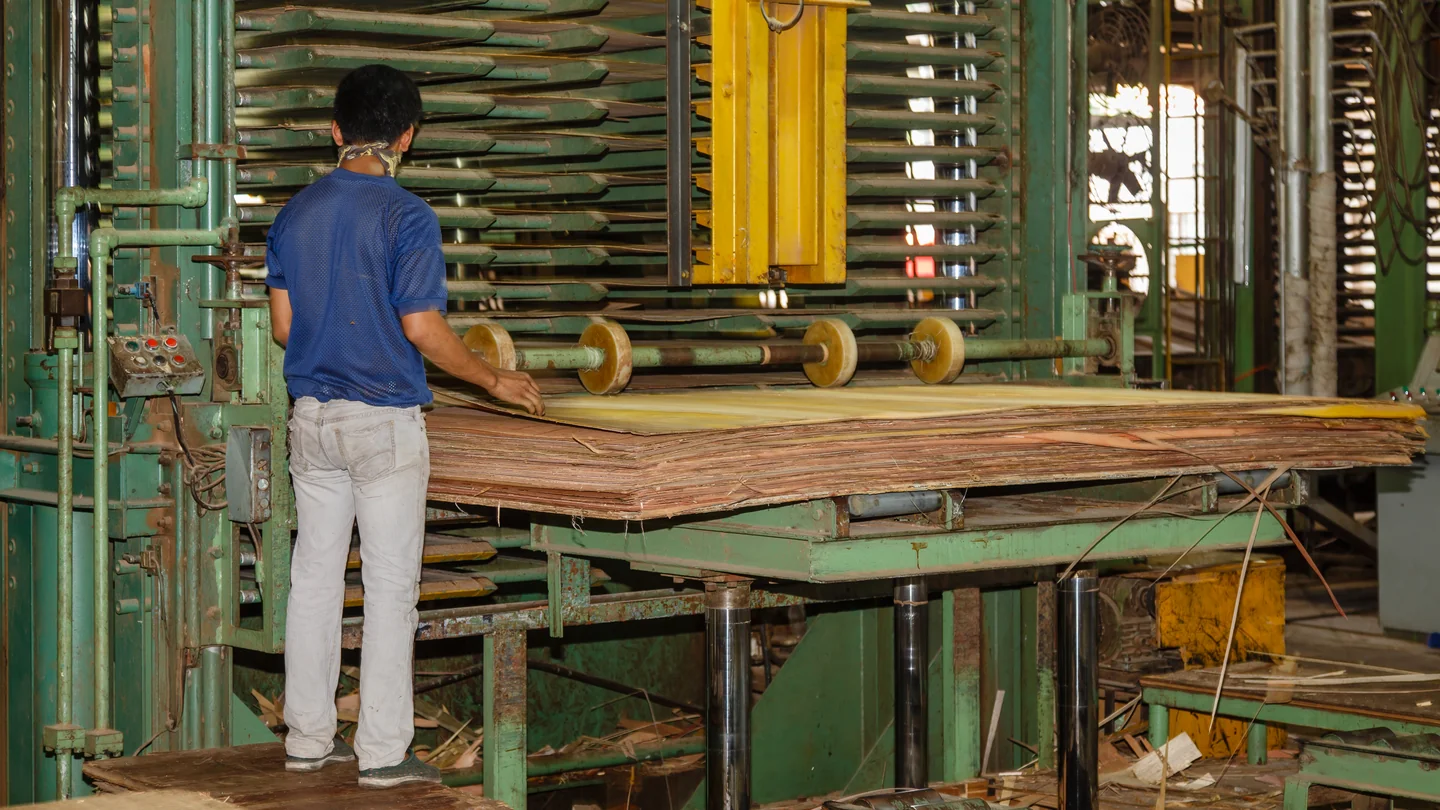
The hot press is selected around loaded area, target specific pressure, number of openings, daylight pitch, platen dimensions, heating method, closing requirements and the desired batch sequence. Openings or daylights describe press positions; plies describe the panel construction and should not be substituted for one another. A multi-daylight press transmits the specified loaded area through the press structure in series. Therefore, do not multiply press force by the number of openings when applying the force estimate.
For a preliminary force check use F[kN]=A[mm2]*p[MPa]/1000, where A is the loaded area represented by the engineering load model and p is the target unit pressure. For example, an assumed 1,370 mm by 2,700 mm loaded area at an assumed 0.8 MPa gives 2,959.2 kN before engineering allowances and verification. This is illustrative only; pressure, loaded area, construction, frame, cylinders, heating and structural limits must be confirmed. Unequal loads require a revised model.
Capacity must be balanced across prepress output, press batch interval, loader travel, unloading and stacking. As an assumed planning example only, 20 effective openings, one panel per opening, a 10-minute complete cycle, an 8-hour shift and 80% utilization produce 20 x 1 x (8 x 60 / 10) x 0.8 = 768 panels per shift. The complete cycle includes loading, closing, pressing, opening, unloading and associated reset or travel when those actions are measured inside the interval. The result is not guaranteed output.
Where one loader serves several presses, estimate occupancy from each press batch interval, loading and unloading service time, and travel between positions. Then check phase conflicts: two presses may request service at once even if average utilization appears acceptable. We can compare a dedicated loader, a shared reciprocating loader or a staged buffer only after the press count, center distances, batch timing and preferred priority rules are known.
| Selection item | Planning question | Required confirmation |
|---|---|---|
| Press openings | How many panels are loaded in one batch and what opening pitch is available? | Effective openings, daylight pitch, panel stack height and loading clearance |
| Loaded area and pressure | What panel area is actually under pressure and what unit pressure is required? | Panel dimensions, pressure basis, load distribution, frame and cylinder calculation |
| Complete cycle | Does the interval include all loading, pressing, opening, unloading and reset time? | Timed sequence, recipe assumptions, operator intervention and acceptance definition |
| Outfeed balance | Can unloading and stacking receive the batch without blocking the press? | Stack pattern, stack height, cooling or buffer need and downstream handover |
Unloading, stacking and downstream boundary
After opening, the unloader must receive panels without scraping surfaces, losing orientation or delaying the next batch. The handover can be direct to a stacker, through a transfer conveyor, or through a buffer when cooling and inspection are required. Confirm whether the buyer needs one uniform stack, separate stacks by panel grade or size, alternating orientation, edge alignment, or a defined pallet presentation. These decisions affect gripper or support geometry, travel, controls and floor space.
Stacking is the normal end of this page’s core scope, but it is not the same as finished-product dispatch. Trimming, crosscutting, turning, sorting, sanding, strapping and warehouse transfer should be listed as separate downstream packages. If the project requires any of them, we will define the incoming and outgoing reference points and identify who supplies the adjacent equipment. Do not price beyond the agreed boundary because conveyors appear continuous in a concept drawing.
A proposed layout should show press centerline, loader travel envelope, unloader route, stack locations, operator access, maintenance clearance, forklift lanes and building obstructions. Any “pit-free” arrangement is a specific layout option, not a general promise; it depends on feed height, floor condition, clear height and adjoining equipment. Illustrative layouts require approved drawings before fabrication or installation.
Site interfaces and RFQ package
For an RFQ, send the product schedule, maximum and minimum finished dimensions, thickness range, panel construction, target pressure basis, target output per shift, operating shifts, prepress details, existing press information if applicable, and the preferred starting and ending points of supply. Include a dimensioned factory plan in millimetres with columns, walls, doors, pits, floor levels, crane limits, maintenance paths and available clear height. Mark material flow direction and the proposed locations for electrical cabinets, heat-source connections and operator stations.
Utility information should identify available voltage and frequency, connected-load limits, heat medium and pressure or temperature range, compressed-air quality and pressure, drainage or ventilation needs, and the party responsible for cables, piping and field connections. Do not assume temperature, adhesive recipe, structural capacity, certification, installation support or acceptance performance without written confirmation. We can organize the questions and coordinate a configuration, while the final responsibilities must be allocated in the quotation and technical agreement.
Ask for a line-item quotation separating press, loading, unloading, conveyors, stacking, controls, guarding, spares, packing, transport, installation and commissioning support. State exclusions and optional items beside each line. Define sample requirements, factory checks, site checks, documents, training, interface signals and the method for verifying capacity. Peter can coordinate the next clarification round at +86 151 9045 1115 or qdlookingforward@gmail.com.
Questions about this configuration
Does this line include plywood lay-up and veneer gluing?
Not automatically. The core page starts at a defined prepress-output or staging handover and covers transfer, loading, hot pressing, unloading and stacking. Lay-up, glue application and cold prepress can be added only when their equipment, interfaces and responsibilities are explicitly included.
Is 768 panels per shift a guaranteed output?
No. It is an assumed planning example using 20 effective openings, one panel per opening, a 10-minute complete cycle, an 8-hour shift and 80% utilization. Actual output depends on confirmed panel data, recipe, loading method, travel, availability, safety interlocks and acceptance conditions.
How is press force estimated for a multi-daylight press?
Use F[kN]=A[mm2]*p[MPa]/1000 for the confirmed loaded area and target unit pressure. Do not multiply the result by the number of serial daylights. Frame, cylinders, load distribution and any unequal or multiple loads require engineering confirmation.
What should we send for a first RFQ review?
Send panel dimensions and thickness range, panel construction, output target, prepress handover details, press or opening data, a dimensioned site plan, utilities, material-flow direction, access constraints and the requested supply boundary. Photos with dimensions are useful for confirming elevations and obstructions.