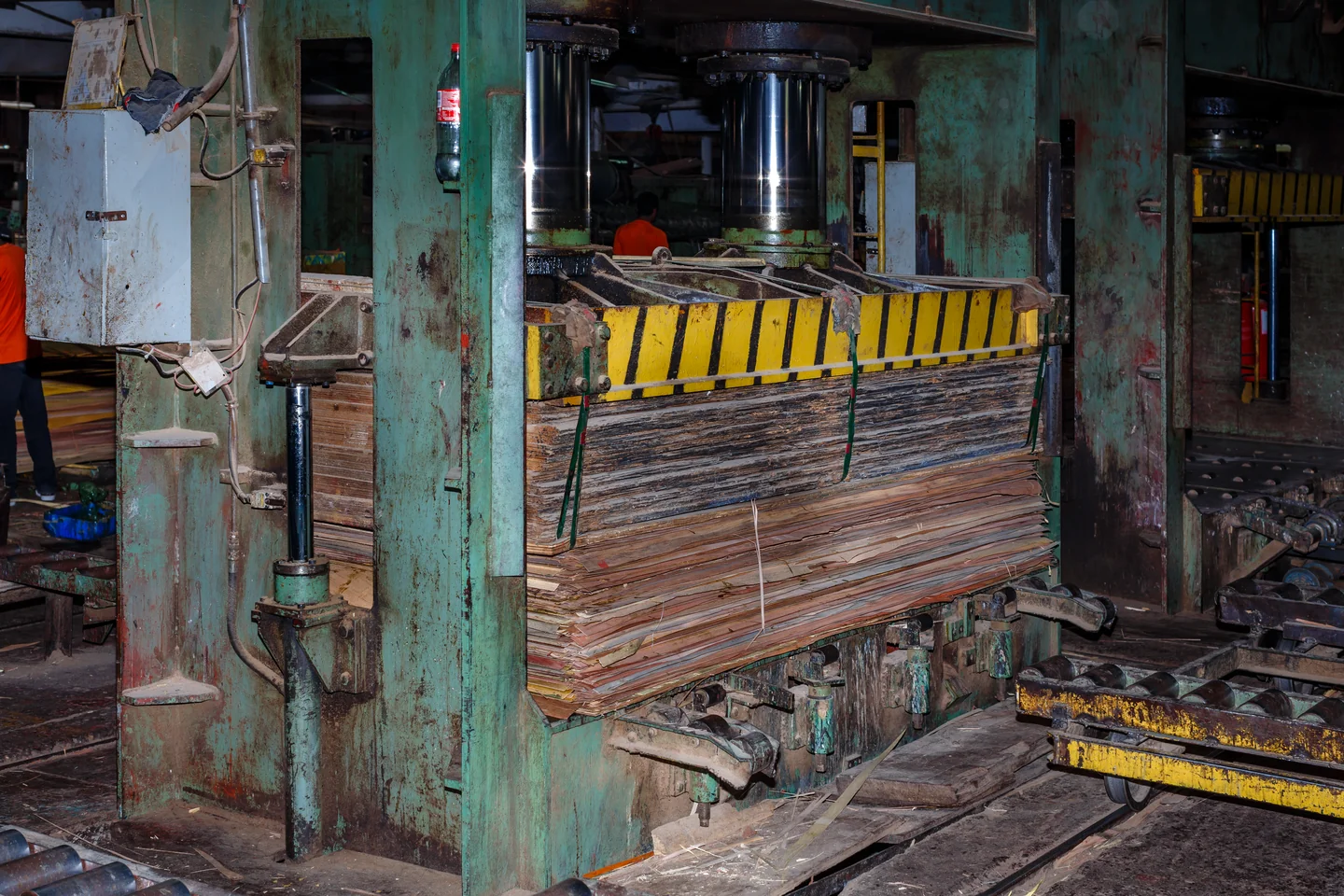
A plywood cold pre-press compacts a freshly assembled veneer lay-up before it reaches the hot press. Its role is to hold the loose plies together, reduce movement during transfer and present a more stable batch for loading—not to replace the heat and pressure process that bonds the panel. The right arrangement depends on the lay-up dimensions, handling direction, batch method and downstream press cycle. We help plywood mills specify and source equipment around these production interfaces.
What the cold pre-press does
Plywood lay-up combines face, long-core and cross-core veneers in the required cross-ply order, with adhesive applied according to the mill’s established process. Before hot pressing, the assembly can be fragile: plies may shift, edges may separate, and the stack may be difficult to move as a unit. A cold pre-press applies mechanical compression to consolidate the lay-up temporarily and improve its handling stability.
This is an intermediate process step. The pre-press does not carry out the thermal bonding performed by a hot press, and it should not be specified as an overlay press, which laminates a facing to an existing substrate. The pre-pressed lay-up still has to be transferred and loaded into the hot press under the plant’s defined process conditions.
Line interface and material direction
A typical sequence is veneer lay-up, cold pre-press, transfer or buffer, hot-press loading, hot pressing, and outfeed handling. The equipment may be arranged for a straight-through line or integrated with a different transfer path, depending on the factory layout and the direction in which lay-ups are assembled and presented.
Confirm where the stack enters and exits the pre-press, which edge leads toward the hot press, and whether the line handles one lay-up at a time or batches multiple lay-ups. Include the loader, transfer table, buffer and hot-press loading method in the interface discussion. A pre-press cycle that appears adequate by itself may still interrupt production if transfer or hot-press loading cannot keep pace.
Loaded area, reference and fit
Describe the loaded lay-up area using its length and width, and identify the datum used to locate it: for example, a defined leading edge, centerline or side reference. The loaded area should reflect the actual veneer assembly presented to the machine, rather than an assumed finished-panel size. Clarify any required clearance for edge alignment, transfer devices or loading tools.
Also document the minimum and maximum lay-up dimensions and thicknesses, the number of assemblies handled per cycle, and the available floor space and transfer elevations. Opening or daylight requirements, where applicable, should be confirmed against the maximum stack and handling method. No machine dimensions or operating limits should be assumed until the supplier has reviewed the production data and interface drawings.
| RFQ item | What to provide | Why it matters |
|---|---|---|
| Panel and lay-up size | Length, width and dimensional range | Defines the required loaded area |
| Stack build | Ply arrangement and lay-up thickness range | Sets the compression and clearance discussion |
| Reference datum | Centerline or edge and transfer direction | Aligns machine and handling interfaces |
| Production target | Batches per shift and cycle observations | Supports capacity and buffer review |
| Downstream press | Loading method, openings and cycle interval | Checks whether pre-press output can be accepted |
What changes machine selection
Selection is shaped by the lay-up envelope, the stack’s handling behavior, the number of assemblies per batch, and the required production rhythm. Product mix matters: frequent changes in panel dimensions or lay-up thickness can influence adjustment needs and operating sequence. The amount of time available between completion of lay-up and hot-press loading should also be stated, since it affects how the pre-press fits into the line rather than establishing a universal setting.
Discuss automation as a complete interface, not as a press-only feature. The proposal should identify what supplies the lay-up, how it is positioned, how the pre-pressed batch is removed, and whether transfer or buffering is included. Ask the supplier to state which equipment and controls are in scope and which connections must be provided by the mill.
Capacity planning and specification review
Compare the pre-press batch interval with the hot press’s actual acceptance interval and the time required by loading and transfer. Use observed or clearly identified planning inputs for loading, closing, pressing, opening, unloading and reset or travel. Avoid counting the same handling time twice. If a shared handling system serves multiple presses, evaluate its travel and service time against the combined demand, then check scheduling conflicts separately.
For an RFQ, include product dimensions, lay-up thickness range, batch size, target shift output, shift pattern, process sequence, line layout and available interface drawings. Request confirmation of machine dimensions, operating range, controls, utilities, safeguarding and supply boundaries. Any performance estimate should be tied to stated assumptions and treated as preliminary until the proposed configuration and operating conditions are confirmed.
Questions about this configuration
Does a cold pre-press replace the plywood hot press?
No. It mechanically consolidates the veneer lay-up for handling. The hot press remains a separate downstream process for bonding the panel under the mill’s specified production conditions.
What loaded-area dimensions should we send for quotation?
Provide the lay-up length and width range, its locating datum and transfer direction, plus the lay-up thickness range and batch arrangement. Finished-panel dimensions alone may not define the assembly presented to the pre-press.
Can pre-press capacity be specified from the target output alone?
Not reliably. The estimate also depends on batches per cycle, full cycle timing, utilization, material handling and the downstream hot-press interval. Supply those inputs and identify estimates clearly for review.