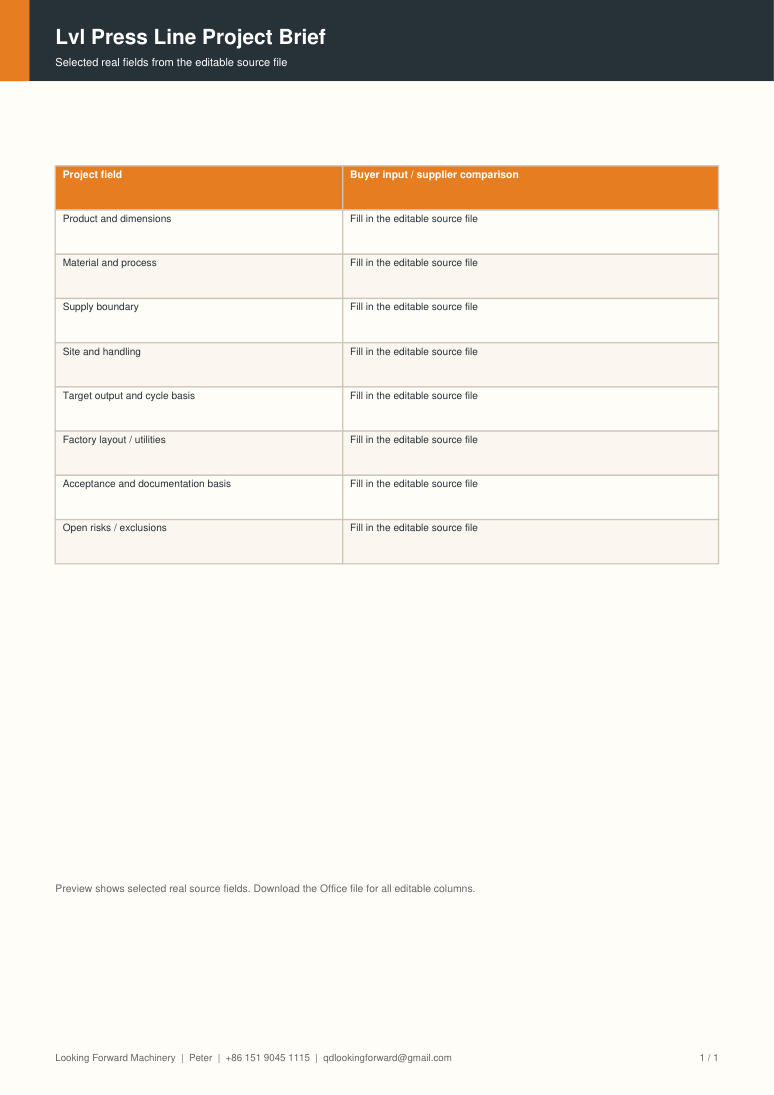
Take the right project data
to the next conversation.
Engineering, production, maintenance and purchasing teams preparing a press-line project.
Information to collect
- length
- width/thickness
- application
- veneer/adhesive recipe to confirm
- supply start/end
- supports
- cutting
- shipping/access
Define the LVL product
Describe billet length, width and thickness, along with the finished sizes and product mix. State whether dimensions are before or after trimming, and identify the length range expected in regular production. Long-platen concepts require particular attention to billet support, transfer, cutting and the available building and shipping envelope. A sample long-platen configuration is not a standard offer; dimensions and feasibility must be confirmed for each project.
Document the process route
Explain how veneers are graded, assembled and joined, and where adhesive application, pre-pressing, cutting or transfer occur. LVL lay-up and hot pressing are distinct process stages. Identify which stages already exist and which are included in the requested supply scope. Do not assume that upstream veneer preparation or downstream billet handling is included with the press.
Capture planning inputs
Use consistent units and distinguish known values from assumptions. Press cycle and shift utilization should reflect the intended production plan; estimated output is for preliminary selection only. For a batch press, a simple panel-output estimate is effective openings × panels per opening × (shift minutes ÷ complete cycle minutes) × utilization. Include loading, pressing, unloading and reset time once within the measured complete cycle. LVL billet handling may require a different production model.
| Input | Record | Unit or note |
|---|---|---|
| Billet dimensions | Length × width × thickness | mm; identify finished or press size |
| Veneer lay-up | Ply sequence and joining route | Describe actual process |
| Press cycle | Complete batch interval | minutes; planning value |
| Shift plan | Hours and utilization | hours; utilization as fraction |
| Line scope | Included and excluded stages | Press, transfer, handling, cutting |
Check handling and site constraints
Provide a layout showing press position, material travel, floor openings or pits, columns, ceiling clearance and access routes. Note how long billets will be supported during transfer and where they will be cut or staged. Confirm available utilities and control interfaces with the relevant project team; missing values should be marked “To confirm,” not treated as fixed design inputs.
Use estimates as a first screen
If a batch-style output estimate is applicable, an assumed example of 20 effective openings, one panel per opening, an eight-hour shift, a 10-minute complete cycle and 0.8 utilization gives 768 panels per shift. This is a hypothetical planning example, not a promised LVL line output. Validate product dimensions, cycle assumptions, process route, press loading and downstream capacity before selecting equipment.
Questions about this configuration
Does this brief define a final LVL press specification?
No. It structures project inputs for preliminary discussion. Press dimensions, force, handling, controls, utilities and supply scope require project-specific confirmation.
Can the output estimate be applied directly to every LVL line?
No. The formula is for batch-style planning where openings and panels per opening are meaningful. Confirm the actual LVL process and cycle model before using an estimate.
What should I do when a project value is unknown?
Mark it “To confirm” and identify who will verify it. Do not replace unknown process or site data with assumed design limits.