Take the right project data
to the next conversation.
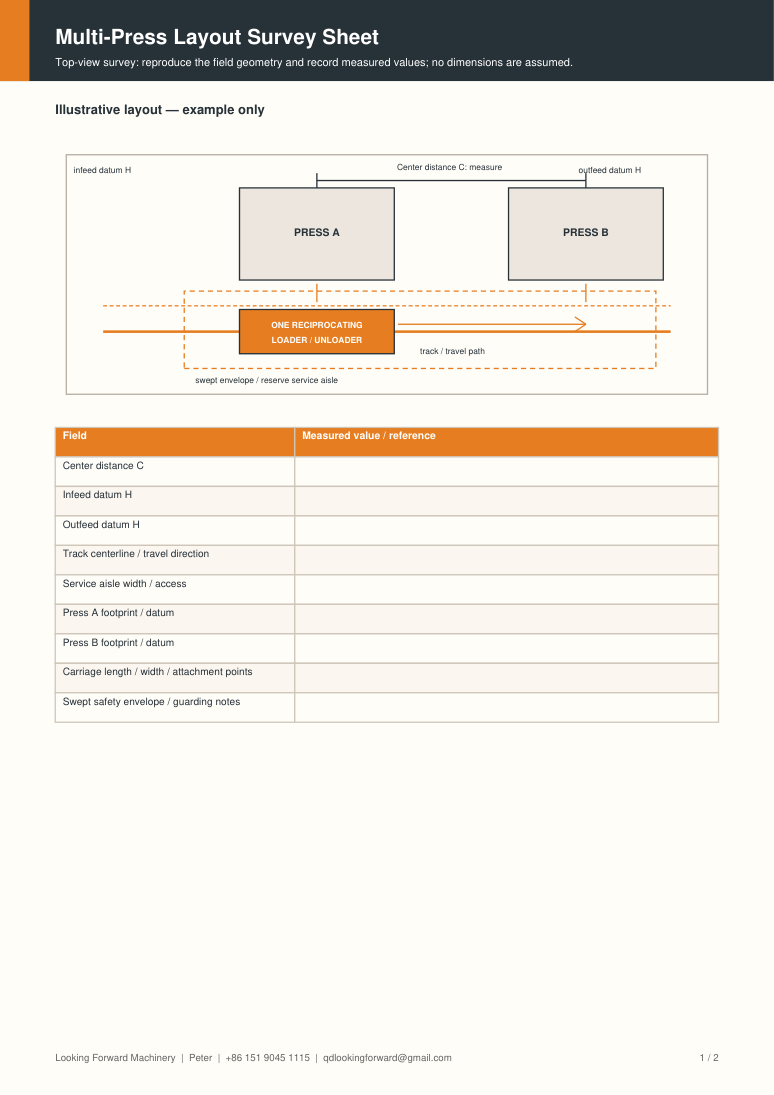
Engineering, production, maintenance and purchasing teams preparing a press-line project.
Information to collect
- one reciprocating carriage
- two presses
- track
- center distance C
- infeed/outfeed datum H
- travel path
- swept safety envelope
- service aisle
- blank measurement fields
What to record
List each press separately, including its location, number of openings, platen dimensions, daylight clearance and loading direction. Record finished panel dimensions and veneer plies as product details; openings and daylights describe the press, while plies describe the veneer lay-up.
For the surrounding area, note aisle widths, columns, walls, pits, floor-level changes, doors and overhead obstructions. Identify the direction panels enter and leave each press, plus the destination of discharged panels.
Capture routes and shared equipment
Sketch material movement from lay-up or buffer through loading, pressing and unloading to stacking or the next operation. For a loader serving multiple presses, record the travel path, service time at each press, batch interval and any points where routes cross or conflict.
Separate existing equipment from proposed equipment. Note the loader and unloader type, transfer devices, controls and interfaces that may affect the arrangement. If a value is unavailable, use “To confirm” rather than estimating it as a measured fact.
Useful survey fields
| Area | Record | Unit or format |
|---|---|---|
| Press | Platen length and width | mm |
| Press | Opening count and daylight | count; mm |
| Product | Panel length, width and thickness | mm |
| Floor | Aisle, pit and obstruction locations | mm; sketch reference |
| Handling | Travel path and service time | mm; seconds or minutes |
Use the sheet for a preliminary review
Compare each press envelope with its loading and unloading clearances, then trace whether the proposed routes can serve the intended presses without blocking adjacent work. A shared loader’s nominal availability can be screened by comparing total service and travel time per batch with press batch intervals; scheduling conflicts and phase overlap still need review.
The sheet is a documentation aid, not a capacity guarantee. Actual output depends on the complete operating cycle, product mix, handling sequence and utilization. We help plywood mills specify and source equipment and configurations; final dimensions, interfaces and suitability remain subject to confirmation.
Example of a completed entry
Hypothetical planning example: record “Press A — 12 openings; daylight: To confirm; platen: To confirm; loading direction: west.” This preserves the known count while clearly flagging measurements still needed. Do not infer force, cycle time or a safe operating value from the layout survey alone.
Questions about this configuration
Should I record every press in the area?
Yes. Include presses that may share loading equipment or affect access, even if they are not part of the initial project. Mark their status and relevant measurements clearly.
What if I cannot measure a dimension?
Enter “To confirm” and identify its location on the sketch. Distinguish estimates from verified measurements so the layout review can prioritize follow-up.
Does the survey establish whether a shared loader will work?
No. It provides inputs for preliminary route and cycle-time review. Equipment fit, scheduling conflicts, interfaces and final suitability require further confirmation.