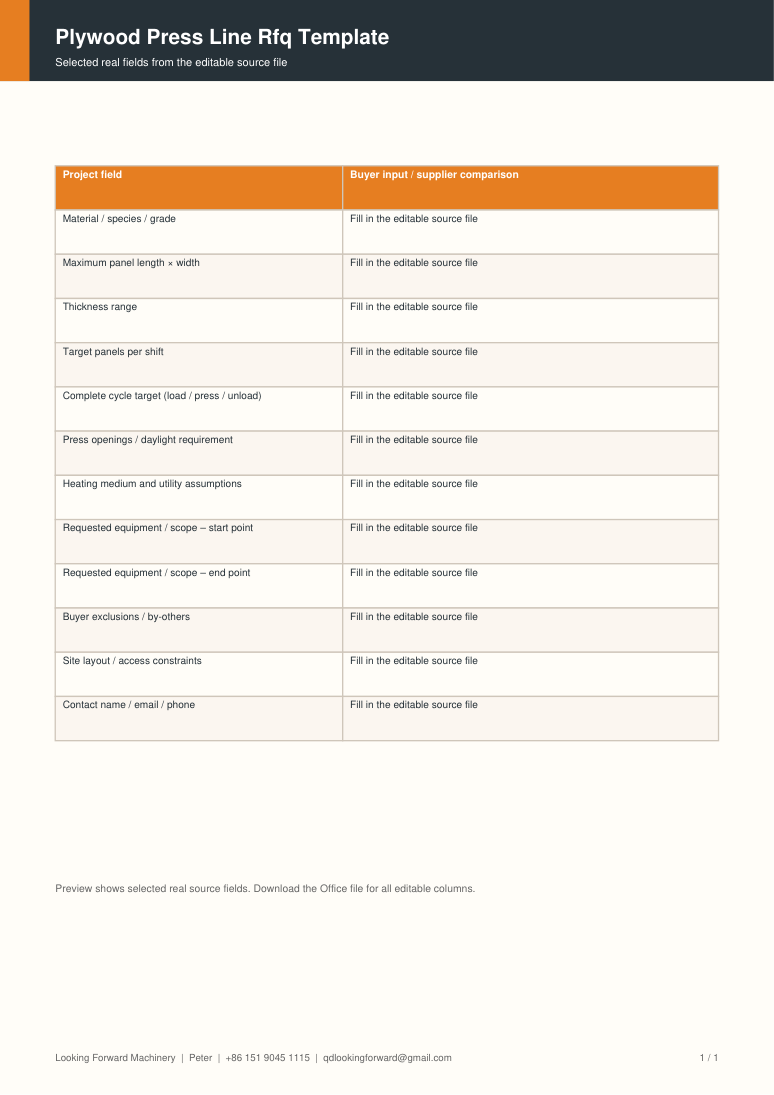
Take the right project data
to the next conversation.
Engineering, production, maintenance and purchasing teams preparing a press-line project.
Information to collect
- material
- maximum dimensions
- thickness range
- target panels per shift
- complete cycle
- openings
- heating/utilities
- scope start/end
- buyer exclusions
- site layout
- contact
Define the product and production plan
List finished panel length, width and thickness, plus the range of products and the veneer lay-up or ply construction for each. Ply count describes veneers; press openings or daylights describe the press. State the required panels per opening and whether products change during a shift. Include target shifts and hours, planned cycle time if known, and the utilization assumption behind any output estimate.
If production is mixed, ask for assumptions and output by product rather than a single headline capacity. Identify the complete cycle interval being used so loading, pressing, unloading and reset time are not omitted or counted twice.
| RFQ input | Units / example format | Why it matters |
|---|---|---|
| Finished panel size | mm: length × width × thickness | Defines product envelope |
| Lay-up construction | Ply count; veneer sequence | Clarifies the panel build |
| Openings and panels/opening | Count; panels per batch | Sets batch capacity |
| Shift and cycle assumptions | hours; minutes; utilization | Frames estimated output |
| Supply boundary | Included / excluded items | Prevents scope gaps |
Specify the press and force basis
Request platen dimensions, opening count, daylight clearance, opening pitch and the intended loading arrangement. Clarify whether the quoted press is for initial hot pressing of glued veneer lay-ups or another operation; an overlay press treats an existing substrate and is a separate application. State heating and control requirements only as confirmed process needs, and leave unresolved values “To confirm.”
For a preliminary force check, use loaded area in mm² multiplied by specific pressure in MPa, then divide by 1,000 for kN. Convert kN to tonne-force by dividing by 9.80665. In a stacked multi-daylight press with equal loaded area transmitted through series, do not multiply force by the number of openings. Unequal or multiple loads, frame design and cylinders require engineering confirmation.
Describe line scope and interfaces
Mark each requested item as included, excluded or optional: veneer lay-up and transfer, pre-press, hot press, loader, unloader, stacking, trimming, controls and integration. Lay-up and hot pressing are separate process steps; clarify which equipment is existing and which is part of the RFQ. For automation, provide the press arrangement, available floor space, material travel routes and known control interfaces.
State what the supplier should identify for utilities, installation, commissioning, documentation, spare parts and acceptance criteria. Do not treat these as included unless the quotation confirms them.
Attach site and quotation information
Provide a dimensioned layout or survey, access constraints, existing press data where relevant, and photographs or drawings that show interfaces. Request a response schedule covering technical deviations, assumptions, exclusions, unresolved inputs and the basis of any capacity estimate. Compare quotations only after aligning scope, product basis, cycle definition and units.
We help plywood mills specify and source press lines and related handling configurations. Contact Peter at +86 151 9045 1115 or qdlookingforward@gmail.com if clarification is needed.
Illustrative output estimate
Estimated panels per shift = effective openings × panels per opening × (shift hours × 60 ÷ complete cycle minutes) × utilization. Hypothetical planning example: 20 effective openings × 1 panel/opening × (8 hours × 60 ÷ 10 minutes) × 0.8 utilization = 768 panels per shift. This is a selection estimate, not a performance guarantee; confirm actual cycle and scheduling assumptions with the line design.
Questions about this configuration
What should I enter if a process value is not known?
Write “To confirm” and identify who will establish it. Do not substitute a guessed pressure, cycle, heating requirement or utility value.
Does ply count mean press openings?
No. Ply count is the number of veneers in the panel construction. Openings or daylights are press positions that can hold batches.
Is the output estimate a guaranteed production rate?
No. It is a planning estimate based on entered openings, batch size, cycle time, shift duration and utilization. Actual output depends on the confirmed process, handling and operating schedule.