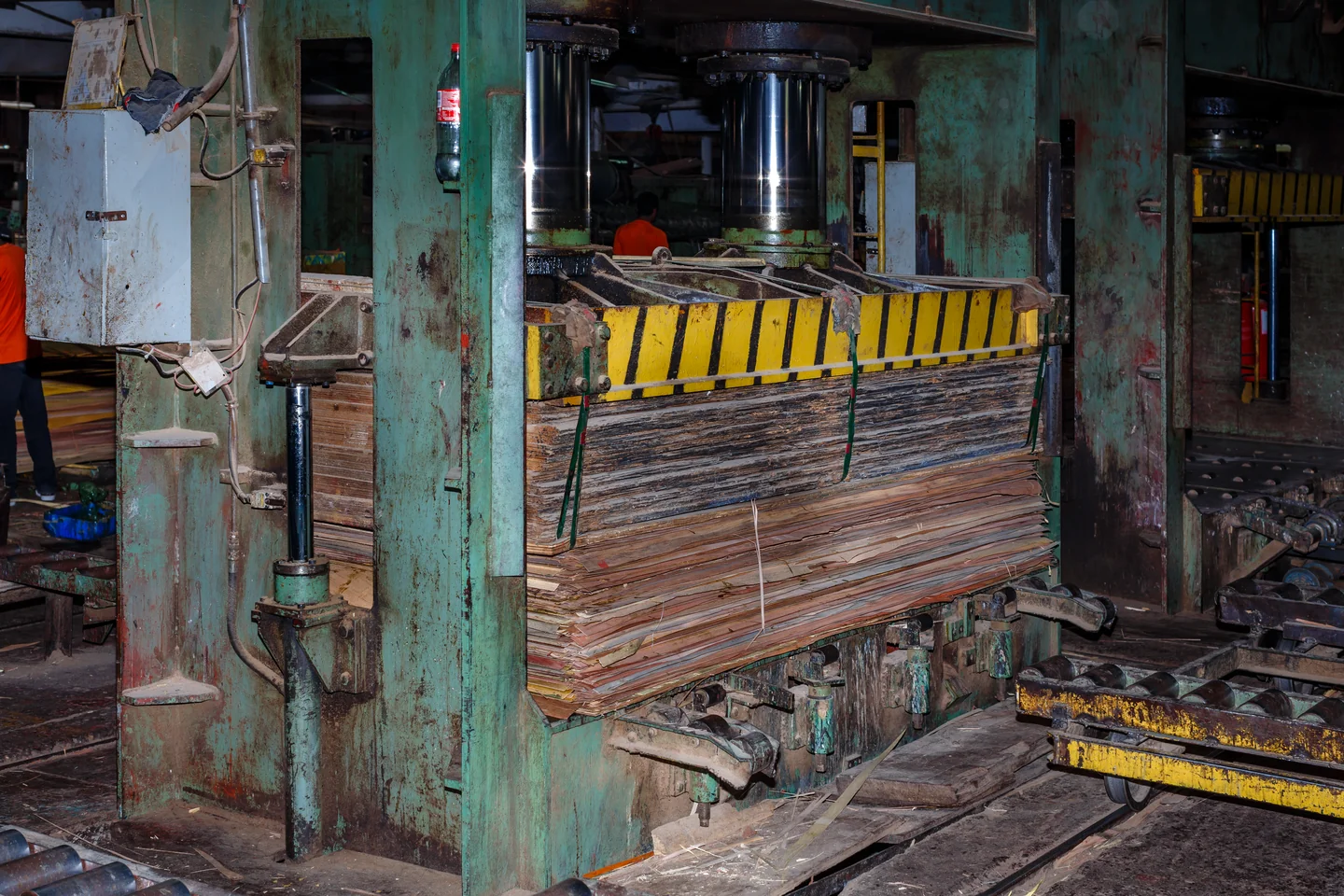
Connecting a cold pre-press to an existing hot press is a material-flow and controls-integration project, not simply a matter of placing one machine before another. The retrofit must fit the press’s actual opening geometry, loading method, production rhythm and safety system. We help plywood mills specify and source a configuration around those conditions. A site survey and clear definition of the loading sequence establish whether the proposed link can transfer prepared veneer lay-ups reliably without disrupting hot-press operation.
Survey the existing press and work area
Begin with the press as it is installed and operated today. Record platen dimensions, opening count, daylight pitch and clearance, opening and closing behavior, existing loader and unloader movements, and the condition of the press-side interfaces. Document the lay-up dimensions and the route from lay-up assembly through the cold pre-press to the hot press.
Measure floor levels, available travel, columns, guards, doors, utilities and any obstructions that could constrain equipment or material. Confirm whether the pre-press and hot press are aligned, offset or separated by an intermediate transfer area. Drawings are useful, but site measurements and operating observations are needed to verify actual clearances and access.
Define the transfer and loading sequence
A cold pre-press consolidates the assembled veneer lay-up before hot pressing; it does not replace the hot press. For plywood, the lay-up consists of veneers arranged in the required cross-ply order. The integration plan should specify how each prepared lay-up exits the pre-press, travels to the hot-press loading position, and enters the intended opening or batch-loading system.
Map each movement, including return travel, temporary staging and any operator tasks. Check that the pre-press discharge rhythm can supply the hot press without creating a queue, and that the hot-press loader can accept the material within its available opening and loading sequence. A buffer may help separate cycle variations, but its size and layout depend on measured cycles, product mix and available floor space.
| Interface point | Confirm before design |
|---|---|
| Pre-press discharge | Lay-up orientation and release method |
| Transfer route | Travel distance, clearance and obstructions |
| Hot-press loading | Opening geometry and loader sequence |
| Cycle coordination | Measured service and batch intervals |
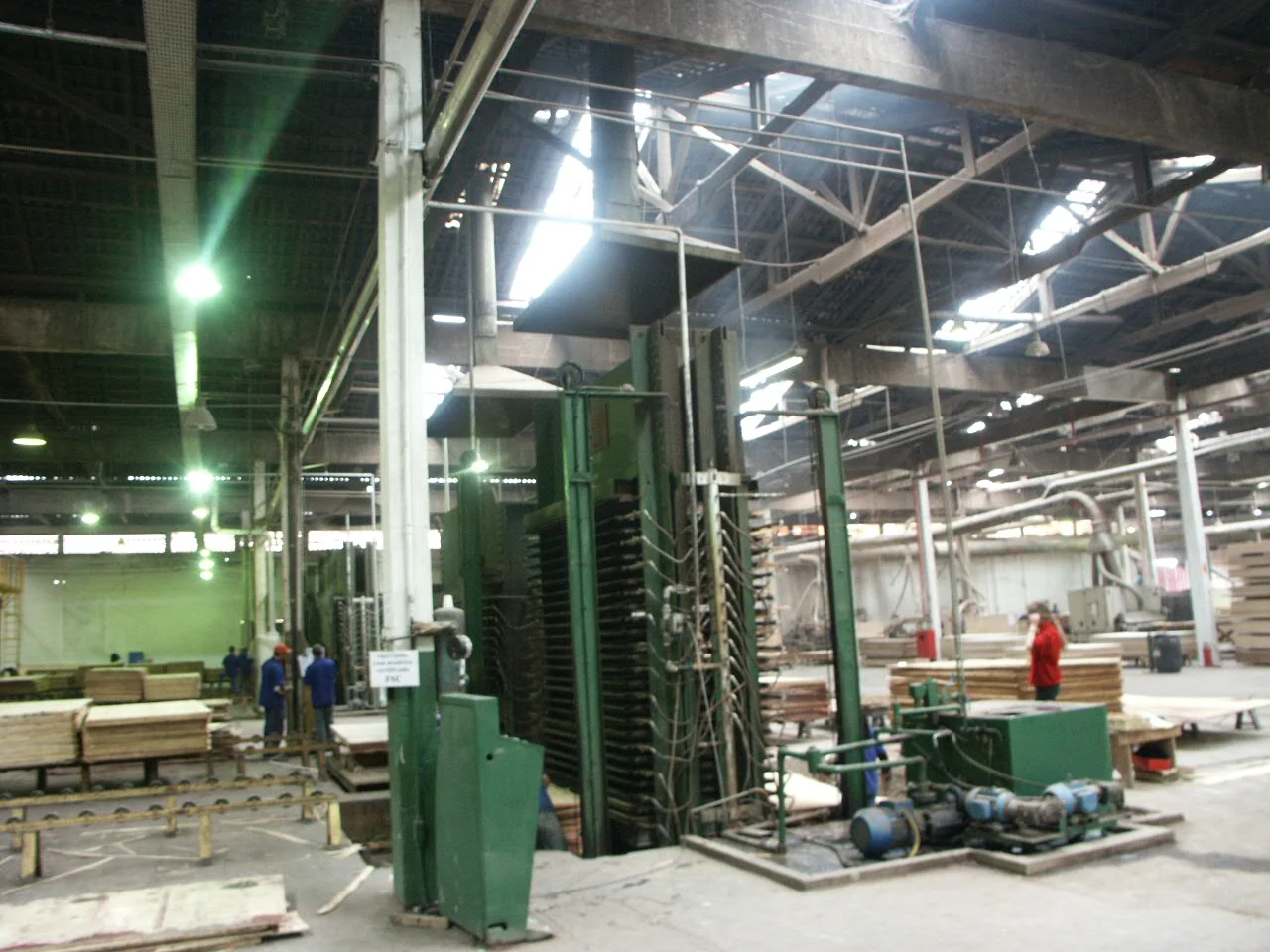
Coordinate controls and safety handshakes
Agree which equipment controls each movement and what information must pass between machines. Typical sequence conditions include pre-press cycle complete, transfer area clear, hot-press loader available, load positioned, and equipment ready to move. The actual signals, electrical interface and control ownership must be confirmed against the existing PLC and machine documentation.
Define permissives and fault responses so that transfer does not begin into an occupied or unavailable area, and the hot-press sequence cannot proceed while loading equipment is in an incompatible position. Review guarding, access, emergency stops and isolation arrangements as part of the integrated risk assessment. Do not assume that an existing machine’s controls or protective devices can be reused unchanged.
Plan installation, shutdown and commissioning
Separate off-site preparation from work that requires stopping production. Before shutdown, confirm the agreed equipment interfaces, drawings, cable and utility routes, installation access, lifting and positioning plan, and responsibilities for modifying existing controls. The shutdown scope should identify when the press and connected equipment must be isolated, and what checks are needed before restart.
Commission progressively: verify mechanical alignment and clearances, test individual movements, check signal exchange and interlocks, then run the agreed material sequence under controlled conditions. Resolve faults and document approved operating modes before routine production. Downtime duration is site- and scope-dependent; it should be planned after the survey rather than promised in advance.
Set measurable acceptance criteria
Acceptance should cover the agreed transfer path, repeatable positioning, sequence behavior, safety functions, fault recovery and operator handover. Record the products and operating conditions used for trials, along with any exclusions or outstanding adjustments. Production-rate targets should be based on measured complete cycles and the mill’s agreed operating assumptions, not on a nominal machine speed alone.
We help plywood mills specify and source the retrofit configuration, with interfaces and project data confirmed for the particular site. Capacity, compatibility, installation scope and acceptance conditions remain subject to engineering review. Do not assume a pit-free layout, a fixed labor reduction or a universal shutdown period; each depends on the existing press, floor conditions and selected handling arrangement.
Questions about this configuration
Can a cold pre-press be connected to any existing hot press?
Not without checking the specific installation. Opening geometry, loader arrangement, travel route, controls, cycle timing and site clearances determine whether a workable connection can be designed. Collect measurements and operating details before selecting equipment.
Does the cold pre-press determine the hot-press cycle?
No. It consolidates the lay-up before hot pressing, while the hot press performs the subsequent pressing step. Their cycles need to be coordinated so prepared lay-ups arrive when the hot-press loading system can accept them.
What should a retrofit acceptance test include?
Agree tests for material transfer and positioning, machine-to-machine signals, interlocks, fault recovery and the operating sequence. Record trial conditions and results, and confirm any production targets using measured complete cycles and agreed assumptions.