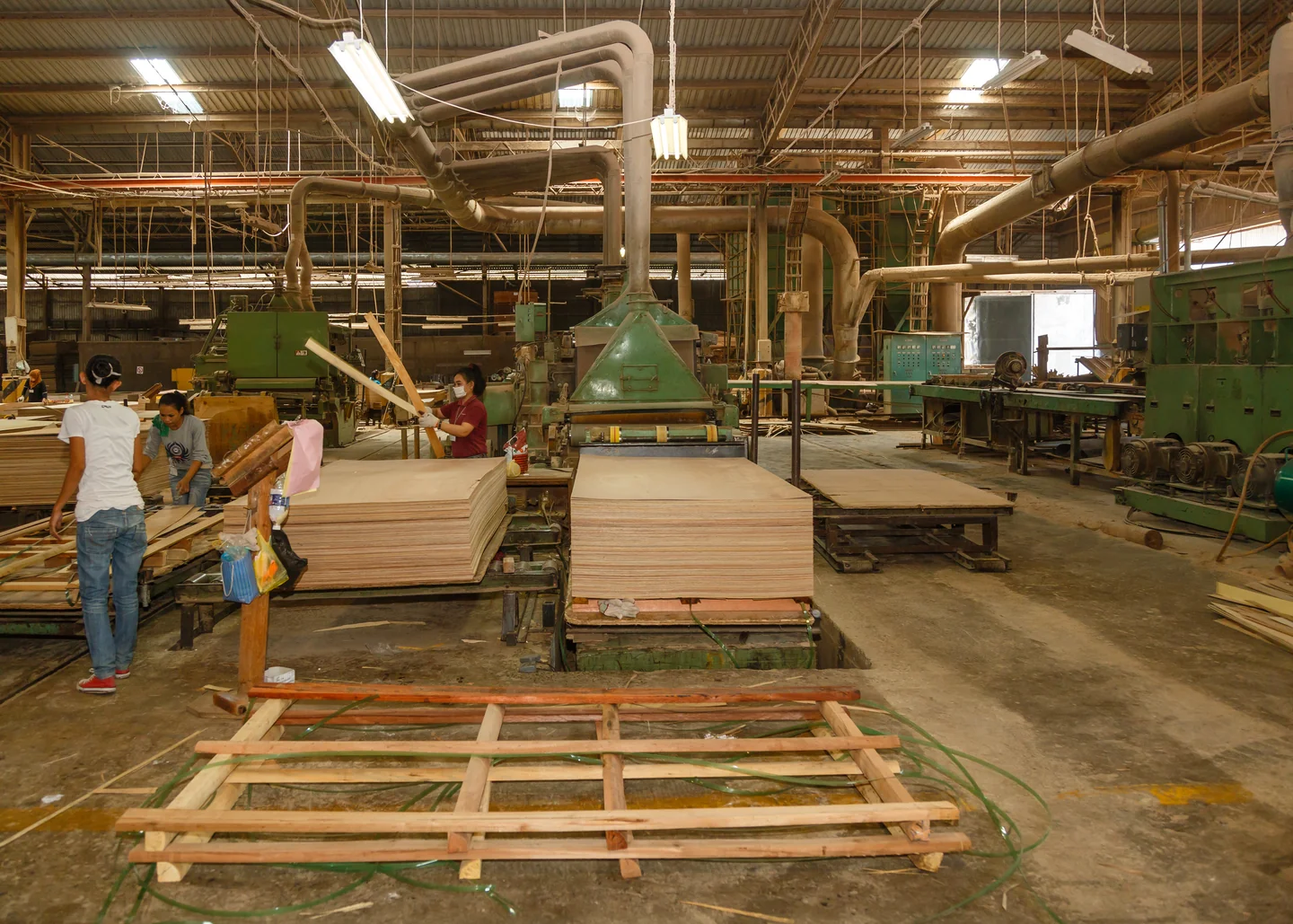
A plywood press retrofit does not end when a hot-pressed panel leaves the machine. If outfeed transfer, cooling or sorting, and stacking cannot keep pace, panels may accumulate at the press and interrupt the next cycle. Retrofitting outfeed stacking means fitting handling equipment to the actual press discharge, product mix, floor layout, and operating sequence. We help plywood mills specify and source a suitable configuration, starting with an interface survey and defining how panels move from discharge to a stable stack.
Survey the press discharge and downstream route
Begin by documenting the existing press and its outfeed condition: discharge height and direction, panel dimensions and thickness range, batch arrangement, cycle sequence, and available clearance. Record the panel path beyond the press, including any turner, inspection point, buffer, cooling area, trimming equipment, or manual handling station. These interfaces determine whether the retrofit can receive panels directly or needs an intermediate transfer.
Measure columns, guarding, floor levels, access routes, obstructions, and the available footprint around the press. Confirm where stacks are built and how they leave the area. Drawings are useful, but site measurements and observation of a representative production cycle help reveal details such as temporary staging and operator access. Fit and civil work remain subject to site and engineering confirmation; no layout should be assumed to be pit-free.
Define the outfeed travel and stacking sequence
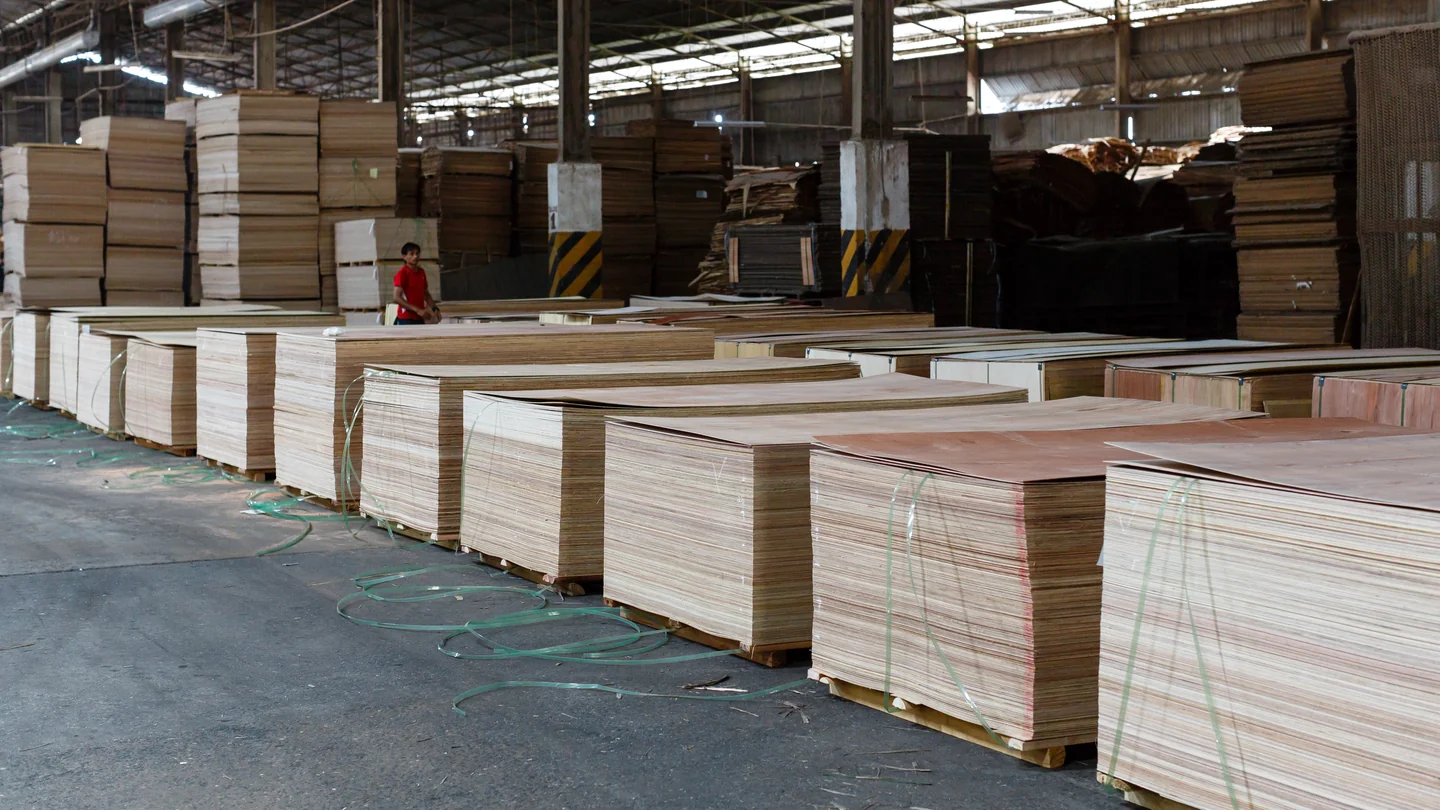
Describe each movement from press opening to completed stack. Depending on the existing line, the sequence may include receiving a batch, separating or transferring panels, orienting them, accumulating a defined group, and placing that group on a stack or pallet. The required arrangement depends on the panel mix and downstream process; an outfeed retrofit is not automatically a trimming, sorting, or cooling system.
Compare the required handling interval with the press’s actual discharge rhythm. Include transfer, return travel, stack change, and any operator actions that share the same working space. Where production includes multiple panel sizes or batches, specify how changeovers and incomplete stacks are handled. Rated speed alone cannot establish line capacity if the press discharge or downstream process sets a slower pace.
| Survey item | What to establish | Why it matters |
|---|---|---|
| Press discharge | Exit direction, height, batch pattern | Defines receiving interface |
| Product range | Panel dimensions, thickness, stack plan | Shapes transfer and stack handling |
| Travel path | Clearances, obstructions, floor levels | Tests layout fit and access |
| Operating rhythm | Discharge interval and reset actions | Checks handling against press cycle |
| Downstream route | Next process and stack removal method | Sets the required outfeed endpoint |
Coordinate controls and safety handshakes
The retrofit must coordinate with the press and any connected downstream equipment. Document the existing PLC and operator controls, available signals, modes of operation, and what happens when a panel is not received as expected. Agree on the sequence for press-open permission, outfeed-ready status, transfer completion, and reset or fault recovery. Exact signal names and logic depend on the installed controls and must be confirmed during integration planning.
Define safe access, guarding, emergency-stop interfaces, and maintenance isolation with the responsible site team and equipment engineers. Interlocks should prevent conflicting machine movements, while recovery procedures should make clear how an interrupted batch is handled. Do not treat a handshake list as proof of safety or assume the existing press controls can accept new equipment without review.
Plan installation, shutdown, and acceptance
Agree the installation boundary before ordering: supplied handling equipment, mechanical connections, electrical work, control integration, and any required site modifications. Prepare access and lifting arrangements, confirm utilities and cable routes, and identify which work can occur before the planned shutdown. The duration and sequence of downtime depend on the surveyed site, scope, and commissioning plan; a fixed shutdown promise is not appropriate without those details.
Set acceptance criteria around the agreed operating sequence and products. Checks can cover transfer alignment, stack position and stability, control handshakes, fault recovery, and repeated operation across the specified product range. Record test conditions, exceptions, and responsibility for resolving issues. Any output target should be measured under agreed conditions and must not be inferred from equipment speed alone.
Specify a retrofit around the real constraint
A useful request for proposal includes press and discharge measurements, product range, observed cycle timing, layout drawings or marked-up photos, control information, and the intended stack format. Identify constraints such as restricted access, shared aisles, or manual stack removal. Information not yet available should be marked To confirm rather than replaced with assumptions.
We help plywood mills specify and source outfeed stacking configurations to suit documented interfaces and production needs. The final arrangement, scope, and performance expectations require engineering and site confirmation. For a focused review, contact Peter at +86 151 9045 1115 or qdlookingforward@gmail.com.
Questions about this configuration
Can outfeed stacking be added without changing the hot press?
Sometimes, but compatibility depends on discharge geometry, control interfaces, available space, and the planned transfer sequence. Survey these conditions before deciding whether the press itself needs modification.
Will an outfeed stacker increase press output?
It may reduce a downstream handling constraint, but it does not by itself increase press capacity. Compare measured outfeed service and reset time with the complete press cycle, then verify performance during agreed acceptance tests.
Can the retrofit be installed without a production shutdown?
That cannot be promised in general. Some preparation may be possible in advance, but final connections, integration, and commissioning depend on the equipment scope and site conditions. Plan and confirm the shutdown with the mill team.