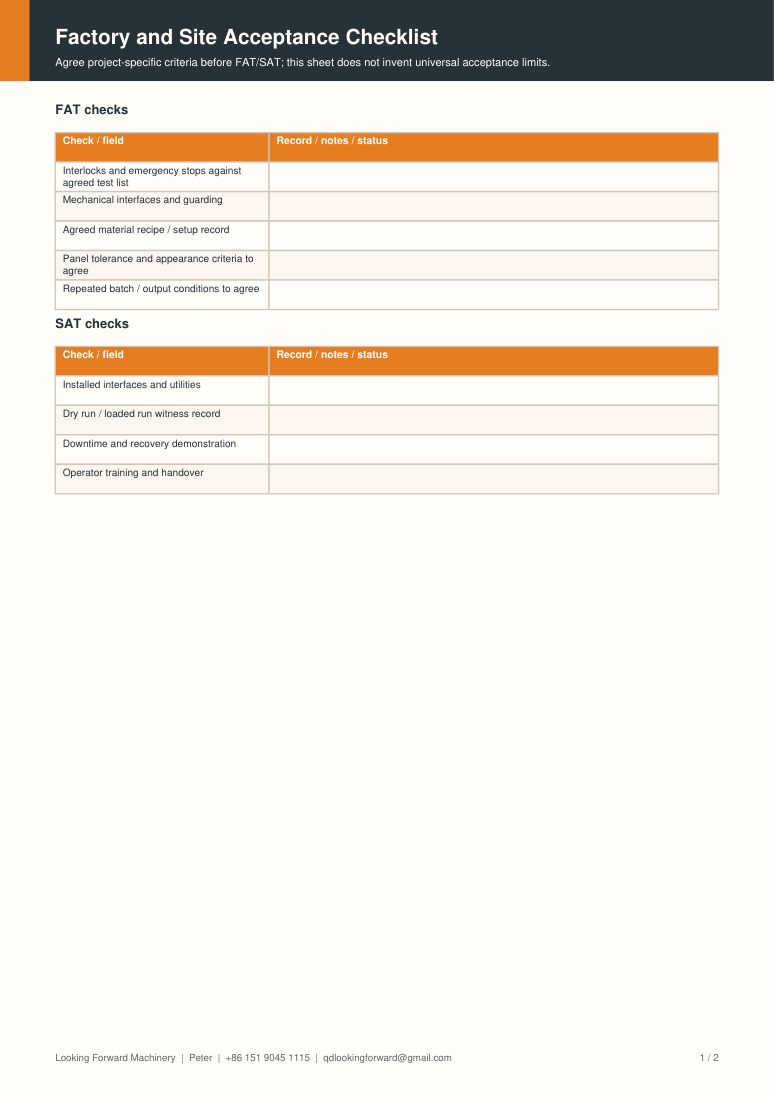
Take the right project data
to the next conversation.
Engineering, production, maintenance and purchasing teams preparing a press-line project.
Information to collect
- FAT
- SAT
- interlocks
- mechanical interfaces
- agreed material recipe
- panel tolerance to agree
- repeated batch/output conditions
- downtime/recovery
- documents
- defect signoffs
Set the acceptance basis
Start with the signed technical specification, approved drawings, scope boundary and agreed exceptions. Identify the equipment included, utilities and controls interfaces, deliverables, and any items explicitly excluded. List each test with its method, instruments or records required, acceptance limit, witness and sign-off responsibility. Where a limit or method is not defined, mark it To confirm rather than creating a new requirement.
For plywood equipment, state the intended panel dimensions, lay-up or product type, operating sequence and relevant line interfaces. A press test should distinguish press functions from upstream lay-up and downstream trimming or stacking unless those systems are included in the agreed scope.
Factory acceptance checks
Review equipment identification against drawings and the bill of scope. Inspect accessible assembly, guards, electrical enclosures, hydraulic or heating connections and finish against the agreed requirements. Check control modes, alarms, interlocks and emergency-stop functions using the approved test procedure.
Run agreed dry cycles and, where the test plan provides suitable material and conditions, representative operating cycles. Record cycle sequence, interruptions, observed faults and measured results. Do not treat an unloaded demonstration as proof of production output or product quality.
| Check | Record or evidence | Acceptance basis |
|---|---|---|
| Scope and identification | Equipment list, tags, deviations | Approved scope and drawings |
| Mechanical assembly | Inspection record and open items | Agreed drawings and requirements |
| Controls and safety functions | Test steps and observed results | Approved control test plan |
| Operating sequence | Cycle observations and faults | Agreed functional sequence |
| Measured performance | Method, conditions, readings | Specified test criteria |
Site acceptance after installation
At the mill, verify installation, anchoring or alignment requirements where specified, utility connections, guarding, access and connection to existing equipment. Confirm that control signals and operating responsibilities at each interface match the approved integration plan. Record unresolved site dependencies separately from equipment defects.
Complete agreed functional tests with trained personnel and representative material where available. For a multi-daylight press, confirm the agreed loading and unloading sequence and clearances; do not assume press force is multiplied by the number of openings. For shared handling equipment, test the planned press sequence and travel paths, not just an isolated motion.
Measure, document and close
Use instruments suitable for the measurement and record identification or calibration status when required by the test plan. Log units, test conditions, readings, deviations and corrective actions. If output or cycle time is assessed, define the start and end points, product mix, interruptions and utilization assumptions; results are meaningful only against those stated conditions.
Classify each item as accepted, accepted with recorded open actions, or requiring re-test, according to the contract or agreed procedure. Assign an owner and due date to each action and retain signed records. Acceptance results verify only the agreed scope and test conditions; they do not replace separate engineering review or end-use compliance assessment.
Questions about this configuration
What is the difference between factory and site acceptance?
Factory acceptance checks equipment and functions available before shipment. Site acceptance checks installation, utilities, controls interfaces and agreed operation at the mill.
Should production output be part of acceptance testing?
Only when output is explicitly included in the agreed test plan. Define product, test duration, cycle boundaries, utilization and measurement method before the test; a demonstration alone is not a guarantee of ongoing output.
What if the specification does not state a pass limit?
Record the item as To confirm and agree a measurable method and acceptance criterion with the relevant parties before testing. Avoid substituting an assumed safe or performance value.