Take the right project data
to the next conversation.
Engineering, production, maintenance and purchasing teams preparing a press-line project.
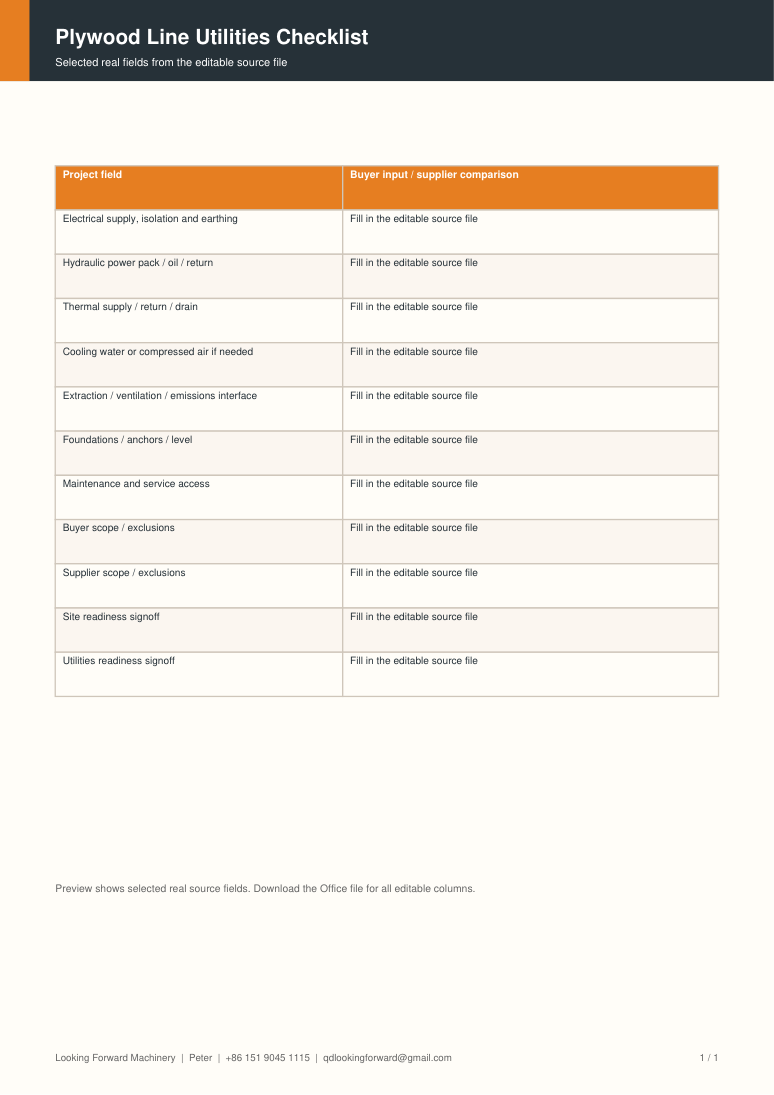
Information to collect
- electrical/earthing
- hydraulic
- thermal supply/return
- cooling/air if needed
- extraction
- foundations
- maintenance/service access
- buyer/supplier scope
- signoff
Define the equipment scope
List each included section, such as veneer lay-up, pre-press, hot press, loader and unloader, stacking, trimming, and dust extraction. Mark existing equipment that will remain and identify which party supplies each connection. Utility estimates are incomplete if they cover the press alone while omitting auxiliaries.
Record site utility data
For each service, capture the source, available capacity, connection location, and measurement basis. Distinguish confirmed readings from assumptions or items still to confirm. Include supply drawings or recent site measurements where available, and note whether other production equipment shares the same service.
| Service to review | Record | Confirm with supplier |
|---|---|---|
| Electrical power | Voltage, phases, frequency, available capacity | Connected load and starting/control requirements |
| Press heating | Existing heat source and distribution | Heating medium, demand, connections, and operating basis |
| Compressed air | Pressure and available flow at connection | Demand profile and air-quality requirements |
| Water or cooling | Source, flow, temperature, and return route if applicable | Whether required and operating conditions |
| Extraction | Duct route and available extraction capacity | Equipment interfaces and design demand |
Check electrical supply
Ask for the proposed equipment load list and electrical interface details after the line scope is defined. Compare these with measured site availability, including shared loads and the distance to the connection point. Cable sizing, protection, earthing, and installation design must be confirmed by qualified project personnel for the actual site.
Confirm heating and auxiliary services
Do not assume a heating medium or demand from another press installation. Identify the plant source and distribution arrangement, then request the equipment-specific operating requirements. Check compressed air, cooling or water, and extraction only where applicable to the selected configuration; mark unverified values as To confirm.
Use estimates as planning inputs
The checklist organizes inputs; it does not calculate a universal utility load. Hypothetical example: a site record might show an existing electrical supply rating and a measured connection distance, while the proposed line demand remains To confirm. Resolve that gap with the supplier before final site design or ordering. We help plywood mills specify and source equipment configurations around their stated requirements.
Questions about this configuration
Can this checklist establish the required utility capacity?
No. It gathers site information for comparison with equipment-specific demand. Final capacity and installation design require confirmed equipment data and site engineering.
Should utilities for the entire line or only the press be listed?
List the complete proposed scope, including handling and auxiliary equipment, and clearly distinguish new equipment from existing plant services.
What if a site value is unknown?
Mark it To confirm and identify who will measure or supply the information. Avoid substituting assumed values for verified site data.