Take the right project data
to the next conversation.
Engineering, production, maintenance and purchasing teams preparing a press-line project.
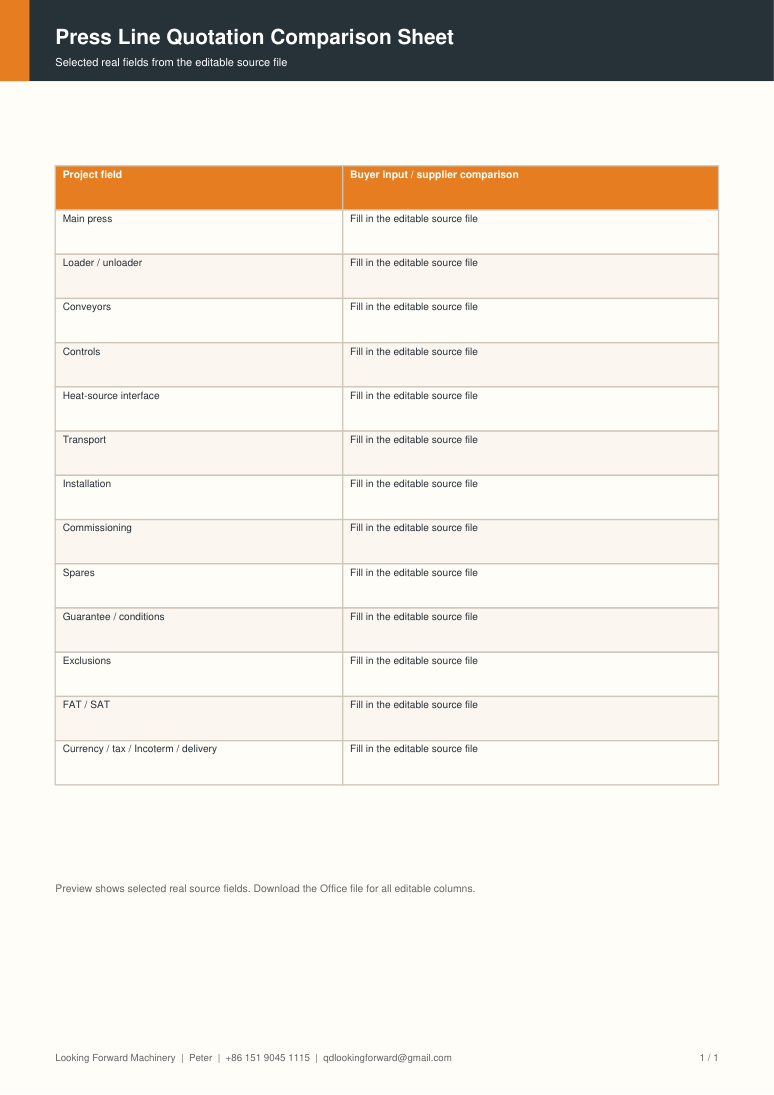
Information to collect
- three supplier columns
- main press
- loader/unloader
- conveyors
- controls
- heat-source interface
- transport
- installation
- commissioning
- spares
- guarantee/conditions
- exclusions
- FAT/SAT
- currency/tax/Incoterm/delivery
- blank prices
Set a common basis
Start with the products and production plan each quotation is expected to serve. Record finished panel length, width, and thickness in millimetres, veneer ply count, batch arrangement, and target output per shift. For plywood, plies describe veneers; press openings or daylights describe the press. Do not compare a supplier’s output estimate with yours unless the cycle and utilization assumptions match.
Note whether the offer concerns initial hot pressing of glued veneer lay-ups or a different process, such as overlay pressing on an existing substrate. These are not interchangeable scopes.
Compare scope item by item
List the press, loading and unloading equipment, transfer, stacking, controls, and other line sections separately. Mark each as included, excluded, optional, or to confirm. Record who supplies foundations, installation, utilities connections, and integration with existing equipment; do not assume these are included because a quotation describes a complete line.
| Comparison item | Record in each offer |
|---|---|
| Press configuration | Opening count, daylight, platen size |
| Handling | Loader, unloader, transfer, stacking |
| Capacity basis | Panels per opening, cycle, utilization |
| Supply boundary | Included, excluded, optional, to confirm |
| Commercial terms | Currency, delivery, payment, validity |
Check capacity assumptions
For a planning estimate, calculate panels per shift as effective openings × panels per opening × (shift hours × 60 ÷ complete cycle minutes) × utilization. Use minutes consistently. The complete cycle should include loading, closing, pressing, opening, unloading, and any reset or travel time measured in that interval; do not subtract those activities a second time.
Hypothetical example: 20 openings × 1 panel per opening × (8 × 60 ÷ 10 minutes) × 0.8 utilization = 768 panels per shift. This is an estimate, not a performance promise. Confirm how each quotation defines cycle time, utilization, product mix, and downtime.
Compare force and dimensions carefully
If pressure and loaded area are stated, estimated total force in kilonewtons is loaded area in mm² × pressure in MPa ÷ 1,000. Convert to tonne-force by dividing kN by 9.80665. For a stacked multi-daylight press with equal loaded area transmitted in series, do not multiply force by the number of openings. Unequal or multiple loads, frame design, and cylinders require engineering confirmation.
Compare platen dimensions with the intended lay-up and handling envelope, not just finished panel size. Record units and ask for clarification wherever the offer omits a basis.
Resolve gaps before selection
Mark every unanswered specification as “To confirm,” assign a responsible party, and request a written response. Compare commercial terms only after scope is aligned, since exclusions and optional equipment can change the basis of comparison. We help plywood mills specify and source equipment and configurations; final selection estimates depend on confirmed project data.
Questions about this configuration
What should I do when a quotation leaves a specification blank?
Enter “To confirm” rather than assuming a value. Ask the supplier to state the specification, unit, and whether it is included in the quoted scope.
Should I compare quoted output directly?
Only after checking openings, panels per opening, complete cycle definition, shift length, utilization, product mix, and included handling. Different assumptions make headline output figures non-comparable.
Does press force increase with the number of openings?
Not in the simple equal-area, stacked multi-daylight model where loads are transmitted in series. Do not multiply force by openings; confirm complex loading and press design with engineering.